
Good TV brands in 2026
As an Amazon Associate I earn from qualifying purchases.Some links may earn us a commission at no extra cost to you.
Brand is a good starting filter, but the series is what decides brightness, motion, gaming features, and black levels. For most people, my #1 “real-life” deciding factor is HDR brightness (nits)—because it determines whether HDR still looks great in a normal living room, not just a dark basement.
How I researched
I compared recent TV roundups and spec sheets, prioritized HDR brightness as the primary “wow factor” in typical rooms, checked HDMI 2.1/VRR/120Hz+ for gaming, and weighed practical ownership stuff like glare handling, ports, and how consistent each brand’s midrange lines tend to be.
Top picks
Sony — Best for sports, movies, and “clean” upscaling
Sony is my safest brand for motion and processing—especially if you watch sports, cable, or mixed-quality streaming. If your room is bright, Sony’s brighter Mini LED lines are usually the best Sony fit.
Why it wins: strong processing + excellent motion, with high-end bright-room options.

- MINI LED BRIGHTNESS AND CONTRAST: Thousands of Mini LEDs are precisely controlled by XR Backlight Master Drive to deliver authentic contrast and our brightest ever 4K TV.
- BILLIONS OF REAL-WORLD QLED COLORS: Access billions of accurate real-world colors with QLED technology and XR Triluminos Pro.
- POWERFUL TV PROCESSING: XR Processor intelligently enhances every scene in real-time boosting color, contrast, and clarity.
Pros
-
Excellent motion for sports
-
Strong upscaling for older/low-bitrate content
-
Great for bright rooms (with the right series)
Cons
-
HDMI port layouts can be limiting on some models
-
Often costs more than value brands
Social proof: See reviews on Amazon.
Who should skip / failure cases: If I need multiple HDMI 2.1 devices plus a soundbar, I double-check ports first (or plan on an HDMI 2.1 switch/receiver). If I only watch in a dark bedroom, I usually get more value from OLED.
Scores: Performance 5/5 • HDR brightness 4/5 • Ease of use 4/5 • Value 3/5
LG — Best all-around OLED brand (movies + gaming)
LG is the default OLED recommendation because the lineup is consistent: deep blacks for movie nights, fast response for gaming, and strong feature support on the mainstream C-series.
Why it wins: OLED contrast + reliable gaming feature set.

- OLED Technology: Celebrating 12 years of perfecting award-winning OLED TV technology
- Brightness Booster: Our Brightness Booster technology magnifies each individual pixel for luminous quality that shines with every detail
- Bright Room Ready: Verified by UL for Discomfort Glare Free (UGR less than 22), you can be confident your LG OLED TV performs well no matter the room or the lighting. With LG OLED you still experience deep black levels that deliver stunning pictures
Pros
-
OLED black levels (great for dark-room viewing)
-
Great gaming support on the right models
-
Solid “set it and forget it” picture modes
Cons
-
Not as bright as top Mini LED TVs
-
Burn-in risk with heavy static content (varies by use)
Social proof: See reviews on Amazon.
Who should skip / failure cases: If the TV runs all day on news or channels with static logos/tickers, I lean Mini LED. If the room is extremely bright, I consider a brighter Mini LED instead of OLED.
Scores: Performance 5/5 • HDR brightness 3/5 • Ease of use 4/5 • Value 4/5
Samsung — Best for punchy HDR and sleek smart features
Samsung’s higher-end TVs tend to look bold and vivid, and gaming features are usually strong. One common dealbreaker: many Samsung TVs don’t support Dolby Vision, so format preferences matter.
Why it wins: vivid HDR + strong premium features on the top tiers.

- OUR MOST ADVANCED 4K AI PROCESSOR: Powered by 128 neural networks to deliver AI-enhanced picture and optimized sound, resulting in an exceptional 4K experience for streaming, gaming, live sports and more.*
- SAY GOODBYE TO DISTRACTING REFLECTIONS: Watch everything you love without distracting reflections so you can get lost in your content —even with sun streaming through your windows or that one lamp you keep on while watching the latest thriller.
- POWERFUL BRIGHTNESS AND DRAMATIC CONTRAST FOR STRIKINGLY LIFE-LIKE PICTURE: See new details and highlights pop off the screen. Our brightest OLED with pixel-level pitch-blacks delivers dramatic contrast for vibrantly detailed picture.
Pros
-
Strong HDR impact on premium lines
-
Great gaming-focused features on higher tiers
-
Smooth, modern smart TV platform
Cons
-
Dolby Vision often not included
-
Quality varies a lot between budget and premium series
Social proof: See reviews on Amazon.
Who should skip / failure cases: If Dolby Vision is a must-have for my streaming setup, I compare Sony/LG first. If I use the TV as a close-up PC monitor, I verify text clarity feedback for the exact model.
Scores: Performance 5/5 • HDR brightness 4/5 • Ease of use 4/5 • Value 3/5
TCL — Best value brand for big screens with Mini LED
TCL is my value pick when I want a large screen plus strong brightness. The key is buying the right line—TCL’s better Mini LED series are the ones that compete with pricier brands.
Why it wins: big-screen brightness/features without premium pricing.

- QD-MINI LED: This premium level Mini LED TV, now with the New TCL Halo Control System, ensures a stunning viewing experience.
- TCL HALO CONTROL SYSTEM: An advanced Technology Suite that includes the New Super High Energy LED Microchip, Condensed Micro Lens, Micro-OD Reduced Optical Distance, High Contrast HVA Panel, Enhanced QLED, Zero Delay Transient Response, Bi-direction 23-bit Backlight Controller, and Dynamic Light Algorithm for Stunning “Halo-Free” Images.
- CRYSTGLOW WHVA PANEL: Stunning picture quality from any seat with the anti-reflective edge-to-edge ZeroBorder* panel that’s designed to deliver vibrant colors and crisp detail from every *ZeroBorder only refers to the hardly perceived BM zone at the edge of the image under normal viewing scene and distance. angle.
Pros
-
Very bright on the right Mini LED series
-
Strong value at 65″ and up
-
Gaming features can be excellent for the price
Cons
-
Motion/processing often trails Sony
-
Built-in sound is usually just “fine”
Social proof: See reviews on Amazon.
Who should skip / failure cases: If I’m extremely sensitive to motion in sports/cinema, Sony can look more natural. If I have wide seating, I check viewing-angle performance for the specific model line.
Scores: Performance 4/5 • HDR brightness 5/5 • Ease of use 4/5 • Value 5/5
Hisense — Best “most TV for the money” (when you pick the right tier)
Hisense is great when I want premium-ish features for less—especially in the U-series. Like TCL, the series matters a lot: entry lines can be basic, while higher lines are the real reason to buy the brand.
Why it wins: strong value with bright Mini LED options in the better series.
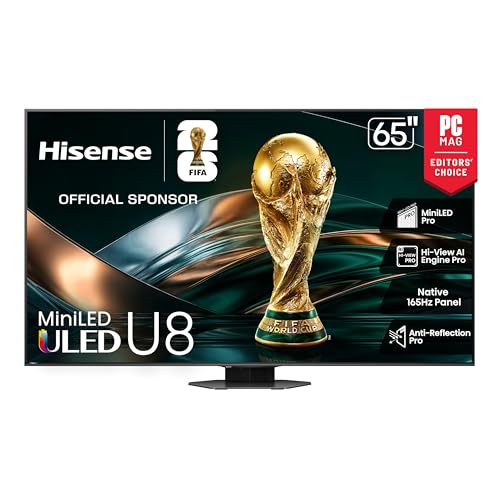
- MINILED PRO WITH UP TO 5000 NITS PEAK BRIGHTNESS AND UP TO 5600 LOCAL DIMMING ZONES: See the realism of every shadow cast by the players and the ball. When your TV is backlit by thousands of tiny LEDs, your viewing experience gets even more precise. Think of the LEDs like thousands of pinpoints of light illuminating your screen. And Full Array Local Dimming creates deeper shadows and brighter highlights, while virtually eliminating halos
- HI-VIEW AI ENGINE PRO: Enjoy the game from home, but feel like you’re there. Powered by the Hisense proprietary chipset, Hi-View AI Engine Pro automatically optimizes the picture and sound based on the content you are watching. This intelligent feature detects, analyzes and adjusts the details, depth and appearance of everything you watch or play, making every visual even more realistic
- NATIVE 165HZ PANEL WITH GAME BOOSTER 288: Turbo power your gaming! The Native 165Hz Panel has a Variable Refresh Rate of 48Hz to 165Hz, almost as fast as your reaction time. AMD FreeSync Premium Pro, Auto Low Latency Mode and Low Latency MEMC eliminate screen tearing and controller lag. And with our new Game Bar you can control multiple game settings right from your TV remote and on-screen display

Pros
-
Strong features for the price on higher lines
-
Often excellent brightness for HDR (model-dependent)
-
Great size-per-dollar in many sizes
Cons
-
Entry models may be 60Hz with limited gaming
-
Quality can vary more than Sony/LG
Social proof: See reviews on Amazon.
Who should skip / failure cases: If I want guaranteed top-tier processing and motion, I usually pay up for Sony. If I want serious gaming (120Hz+), I avoid Hisense entry tiers and stick to the higher series.
Scores: Performance 4/5 • HDR brightness 4/5 • Ease of use 4/5 • Value 4/5
Quick compare
-
Best for sports + “looks good on anything”: Sony
-
Best for movie nights + gaming (dark room): LG OLED
-
Best for bold HDR + premium smart features: Samsung
-
Best big-screen Mini LED value: TCL
-
Best “features for the money” in upper tiers: Hisense
FAQs
What are the top 3 TV brands?
For most shoppers: Sony, LG, and Samsung. I add TCL and Hisense when value is the priority.
Is OLED always better than Mini LED?
No. OLED usually wins for dark-room contrast, but Mini LED often wins in very bright rooms and can be a safer choice for heavy static-content viewing.
Do I need 120Hz?
If I game (especially competitive) or I’m picky about smooth motion, yes. If I mostly watch movies and shows, it’s nice but not required.
What’s the biggest brand trap?
Buying a brand’s entry series expecting the flagship look. The series decides brightness, local dimming, motion, and gaming support.
As an Amazon Associate, I earn from qualifying purchases.