
Best Whole House Water Filter System for Apartments & Small Homes
As an Amazon Associate, I earn from qualifying purchases. Some links may earn us a commission at no extra cost to you.
A whole-house (point-of-entry) water filter treats water for every shower, faucet, and appliance. What matters most is flow rate (GPM)—because a system that filters well but throttles flow can make showers feel weak when more than one fixture runs.
How I researched
How I researched — I compared current whole-house system categories (multi-canister, tank-style, and budget prefilters), prioritized flow rate (GPM) as the primary comfort metric, checked city-vs-well fit, looked for clear maintenance expectations and common replacement formats, noted when exact specs/variants looked unclear, and weighed filtration breadth against long-term ownership effort.
Top picks
iSpring WGB32B — Best for most homes on city water
A straightforward 3-stage canister setup is often the most practical starting point for city water: sediment protection up front and carbon filtration for taste/odor and common chlorine-related complaints.
Why it wins: A balanced, widely used format that’s usually easy to maintain and expand later.

- Chlorine-Free, Pure Water: Shield your family and appliances with the WGB32B whole house water filter-eradicating up to 99% of chlorine, along with sediments, rust, tastes, odors, herbicides, and more for clean, odor-free water
- Easy DIY Setup: Utilize our manual and YouTube guides for straightforward installation. Featuring 1" NPT inlet/outlet and 20" x 4.5" filters, this whole house water filtration system maintains robust water flow (up to 15 GPM) with minimal maintenance
- Premium Filtration: The first stage sediment filter reaches 5 microns, while the second and third stage CTO Carbon Block filters use quality coconut shell carbon-tested by a third-party to meet NSF/ANSI standards. The system has a 100,000-gallon capacity for a year's supply

Pros
-
Practical all-around system layout for city water
-
Large-housing format is typically maintenance-friendly
-
Good “starter” whole-house foundation for many homes
Cons
-
Doesn’t address hardness/scale (needs separate softening)
-
Not tailored for severe well-water chemistry issues
Trade-offs / who should skip (failure cases)
-
Skip if hardness/scale is the main issue (look at softening solutions).
-
Skip if well water has strong iron/sulfur odors (use a well-focused system).
Scores: Performance 4/5 · Flow rate (GPM) 4/5 · Ease of use 4/5 · Value 5/5
Aquasana Rhino EQ-1000 — Best for low-maintenance, long-life filtration
Tank-style, long-capacity systems appeal to people who want fewer major media changes. This style is often chosen for “set it and forget it” ownership—within the limits of its flow capacity for the home.
Why it wins: Lower day-to-day maintenance feel compared with frequently swapped canister stages.
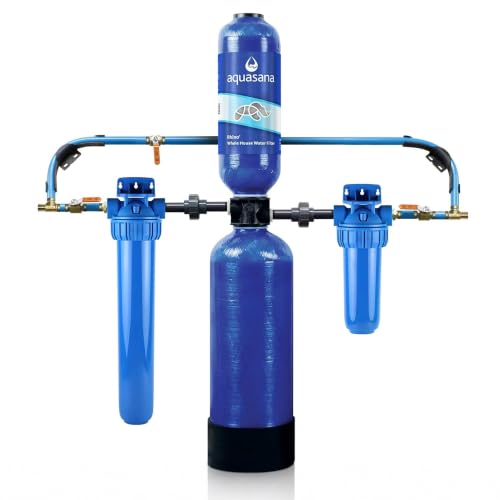
- Clean, Great Tasting Water From Every Tap In Your Home - Activated carbon reduces 97% of Chlorine. Plus, this Rhino's newly-improved divider valve enables a fast and reliable flow rate with no noticeable change in water pressure.
- High-Performance Filter System - Carbon & KDF filtration media engineered to maximize contaminant reduction while leaving healthy minerals in your water. This system will NOT reduce Total Dissolved Solids (TDS)
- Cost Efficient & Long Lasting - Clean water for less than $0. 01 a gallon - Save twice as much compared to other brands on purified water for 1 million gallons or 10 years
Pros
-
Long-life, low-fuss ownership style
-
Designed as a whole-home media approach
-
Good fit for households prioritizing fewer major service events
Cons
-
May feel limiting in high-demand, multi-shower households
-
Install and service can be more involved than basic canisters
Trade-offs / who should skip (failure cases)
-
Skip if the home regularly runs multiple showers and appliances at once—prioritize higher-flow systems.
-
Skip if a simple DIY canister swap setup is preferred.
Scores: Performance 4/5 · Flow rate (GPM) 3/5 · Ease of use 3/5 · Value 3/5
Home Master HMF3SDGFEC — Best for well water with odor/iron-type problems (get a water test)
Well water varies a lot, so systems aimed at iron/sulfur-type issues can be a better starting point than city-water carbon-first designs—assuming a water test matches what the system is meant to handle.
Why it wins: A more purpose-built direction for common well-water complaints while still aiming to protect household flow.
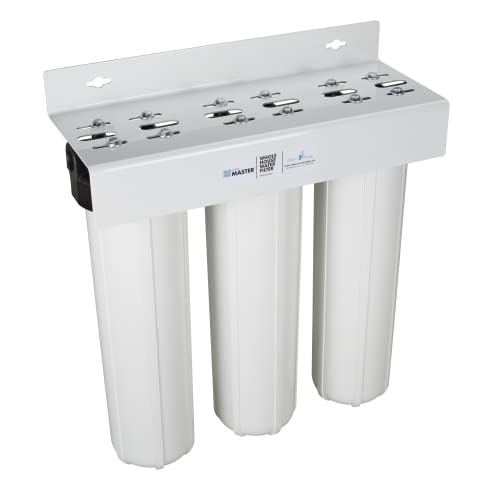
- Optimal Performance for Well Water: Specifically engineered to tackle well water contaminants, this system excels in removing up to 95% of iron, manganese, sediment, chemicals, and other pollutants, ensuring clean and clear water devoid of foul tastes and odors. For city water users, consider the Model #HMF2SmgCC for tailored filtration.
- High Flow Rate and Pressure: Features massive filter housings with 1-inch ports that maximize water flow across your entire home. Experience strong, consistent water pressure with a capability of up to 15 gallons per minute.
- Advanced Filtration Technology: Includes a 4-layer 25-10-5-1 micron replaceable sediment filter that not only provides finer filtration but also boasts a greater dirt holding capacity, reducing the frequency of maintenance.
Pros
-
Well-water-oriented filtration approach
-
Typically chosen for odor and staining-type problems
-
Often a better match than city-water-focused systems for wells
Cons
-
Not universal—well water needs testing to avoid mismatch
-
Still not a hardness/scale solution on its own
Trade-offs / who should skip (failure cases)
-
Skip if there’s no recent water test—wrong system choice is common on wells.
-
Skip if hardness/scale is the main complaint (separate softening is usually needed).
Scores: Performance 4/5 · Flow rate (GPM) 4/5 · Ease of use 3/5 · Value 4/5
GE GXWH20T — Best budget whole-house “starter” filter
A single-housing whole-house filter is a budget-friendly first step, especially when the goal is basic sediment reduction and a simple, compact install. Results depend heavily on choosing the right cartridge for the water.
Why it wins: Low complexity and lower cost of entry than multi-stage systems.

- Reduces sediment and impurities in your plumbing and appliances
- Easy to install with included installation kit
- Filters water at the supply using FXWTC, FXPWC, FXWSC or FXUSC filter
Pros
-
Simple starter approach
-
Easier install/maintenance than multi-stage rigs
-
Useful as a prefilter before other equipment
Cons
-
Single-stage limitations vs multi-stage filtration
-
Cartridge choice matters a lot for results
Trade-offs / who should skip (failure cases)
-
Skip if the goal is whole-home taste/odor improvement—multi-stage carbon is usually better.
-
Skip if well water has iron/sulfur issues—choose a well-focused setup.
Scores: Performance 3/5 · Flow rate (GPM) 3/5 · Ease of use 4/5 · Value 5/5
Express Water WH300SCKP — Best “ready-to-mount” 3-stage frame-style setup
Frame-mounted 3-stage systems are popular for utility-room installs where clean mounting and service access matter. This style is often chosen when a “complete, mounted rig” is preferred over assembling housings and brackets separately.
Why it wins: A more organized, install-ready feel than piecing together a multi-canister layout.

- WHOLE HOUSE WATER FILTRATION: Notice the difference immediately with 3-stage water filtration process throughout your home. From every faucet enjoy crystal clear, drinkable, water and protect your health, pipes, and appliances.
- COMPREHENSIVE FILTRATION SYSTEM: The ULTIMATE PROTECTION system was specifically designed to significantly reduce Chlorine, Heavy Metals (Lead, Arsenic, Chromium +More), and stop scale build-up in whole home water supply.
- DELUXE WATER FILTER: With the Express Water Deluxe Series you get a heavy duty stainless steel bracket and free-stand frame. The system includes pressure release buttons for each filter and pressure gauges for system monitoring and ease of filter change.
Pros
-
Frame layout can simplify mounting and filter access
-
3-stage design supports broader filtration than single-stage
-
Good for garages/utility rooms with enough space
Cons
-
Exact, manufacturer-published GPM can be unclear for some variants
-
Larger footprint than compact wall-mounted options
Trade-offs / who should skip (failure cases)
-
Skip if the home requires guaranteed high flow—choose a system with clearly published flow specs for the exact variant.
-
Skip if install space is tight—framed systems can be bulky.
Scores: Performance 3/5 · Flow rate (GPM) 3/5 · Ease of use 4/5 · Value 4/5
Waterdrop G3P600 (Under-sink RO) — Best add-on for ultra-clean drinking water (NOT whole-house)
This one is important: Waterdrop G3P600 is an under-sink reverse osmosis system, not a point-of-entry whole-house filter. It won’t treat shower/laundry water for the entire home, but it can be a strong drinking/cooking water solution when paired with a whole-house sediment/carbon system.
Why it wins: Great “two-layer” approach—whole-house for general water + RO at the kitchen sink for the cleanest drinking water.

- [Trusted certifications]: Waterdrop G3P600 reverse osmosis system is certified against NSF/ANSI 58 for TDS reduction and NSF/ANSI 372 certified for lead-free material. Also it has been tested and certified against NSF 42 to reduce chlorine, bad taste and odor. The tankless reverse osmosis system is also certified by the Federal Communications Commission. Besides, it meets the EU Standards and UKCA Standards for safety
- [8-stage filtration]: Tested by official third-party laboratory (SGS), the reverse osmosis system can effectively reduce TDS, chromium, PFAS, radium, fluoride, arsenic salt, iron, calcium, particles, chloride, chlorine and radioactive substances in your tap water. And our RO water filter system can reduce chemicals such as vinyl chloride, ethylhexyl acrylate, isobutylene, ethylene glycol, according to the reverse osmosis membrane technical manual
- [Smart display faucet]: The tankless reverse osmosis system is built with a smart display faucet. For instance, the TDS monitor tells you the quality of your filtered water, while the filter life tracker shows how soon you need to replace your filter
Pros
-
Targets drinking/cooking water quality at the point of use
-
Useful when contaminant concerns go beyond taste/odor
-
Good complement to a whole-house prefilter system
Cons
-
Not a whole-house solution (won’t improve shower water)
-
Needs under-sink space + power and periodic filter swaps
Trade-offs / who should skip (failure cases)
-
Skip if the goal is better water “everywhere”—choose a true whole-house system first.
-
Skip if under-sink space/electric access is limited.
Scores: Performance 4/5 · Flow rate (GPM) 2/5 (not comparable to whole-house) · Ease of use 4/5 · Value 4/5
Quick compare
-
Best overall for most city-water homes: iSpring WGB32B
-
Best low-maintenance, long-life style: Aquasana Rhino EQ-1000
-
Best direction for common well-water issues (with testing): Home Master HMF3SDGFEC
-
Best budget starting point: GE GXWH20T
-
Best frame-style 3-stage layout: Express Water WH300SCKP
-
Best kitchen RO add-on (not whole-house): Waterdrop G3P600
Buying guide: how to choose the right whole-house system
1) Choose by flow rate (GPM) first
Whole-house comfort is about handling simultaneous demand (showers, laundry, dishwasher). Higher-flow systems are typically better for 3–4 bathroom homes or busy households.
2) City water vs well water determines the “right” filtration
-
City water: often prioritizes sediment + carbon for chlorine taste/odor.
-
Well water: may require targeting iron, sulfur odors, or fine sediment—testing matters.
3) Filtration isn’t softening
If scale buildup is the main complaint (spots, crusty fixtures, shortened appliance life), a softener or dedicated scale-control approach is often needed in addition to filtration.
4) “Whole-house + under-sink RO” can be a smart combo
A whole-house system improves general water and protects plumbing/appliances, while an under-sink RO system can handle drinking water concerns at the kitchen sink. Just don’t confuse RO under-sink units with point-of-entry systems.
FAQs
What’s the best whole house water filter system overall?
For many homes on city water, a multi-stage canister setup is the most practical starting point because it’s straightforward, modular, and easy to service.
Is a whole-house filter worth it if there’s already a fridge filter?
Yes if the goal is better shower water, cleaner water for laundry/dishwasher, and filtration at every sink—not just the kitchen.
Should the water be tested first?
For well water, yes—testing is the easiest way to avoid buying the wrong system. For city water, it’s still helpful if there are specific concerns beyond taste/odor.
Will a whole-house filter fix hard water?
Usually not. Hardness is typically a softener/scale-control problem, not a basic filtration problem.
Is Waterdrop G3P600 a whole-house system?
No. It’s an under-sink reverse osmosis system intended for one faucet (drinking/cooking water), not the entire home.
As an Amazon Associate, I earn from qualifying purchases.