
Best Propane Heaters for Your Garage (Quiet, Fast, and Safe)
As an Amazon Associate I earn from qualifying purchases. Some links may earn us a commission at no extra cost to you.
If you just need to take the chill off a one- or two-car garage, a fan-blown “torpedo” (forced-air) propane heater warms the space fast. For quieter, closer-range warmth at a workbench, an indoor-safe radiant unit is better. If you want a permanent solution, a ceiling-mounted unit heater (properly vented and set up for LP) is the set-and-forget option. Safety first: follow the manual, ventilate, and use a CO alarm.
How I researched
I compared late-2025 product manuals and maker pages first, plus credible hands-on write-ups where available. I prioritized warm-up speed, safety systems (ODS/tip-over, clearances, venting), BTU range and fuel draw, noise, and ease of use/installation. I verified US variants and model numbers, checked propane (LP) conversion requirements, and flagged anything I couldn’t verify. Scores weigh heat output vs. garage use, noise, ease of setup/maintenance, and overall value.
Top picks
Mr. Heater MH60QFAV (30–60K BTU) — Best for most 1–2-car garages
A fast-warming, variable-output forced-air unit with a quieter burner you can talk over.
Why it wins: Wide 30–60K BTU range and a quieter-than-typical burner make it a sweet spot for quick heat without as much fan drone.
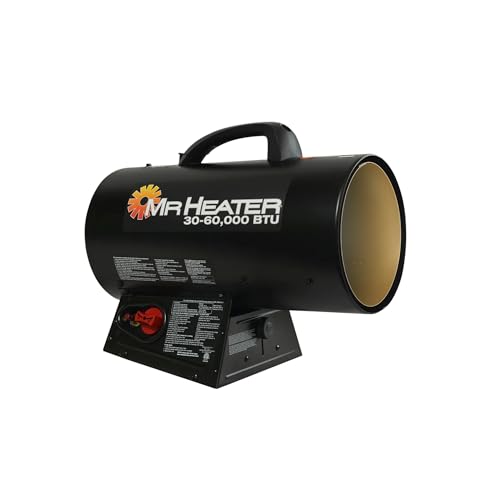
- QBT Technology - 50% Quieter than a standard propane heater
- 60,000 BTU Propane Forced-air Heater"
- Variable 30,000-60,000 BTU Output (Runs Up To 14 hrs on 20 lb. tank (low setting))
Pros
-
30–60K BTU variable dial for better control
-
Quieter burner vs. typical torpedoes
-
Clear clearance and ventilation notes in manual
-
Includes hose/regulator for a 20-lb tank
Cons
-
Fan noise still present on high
-
Not for living spaces; ventilation required
-
No built-in thermostat
Social proof
Owners consistently praise the fast warm-up and simple setup. See rating & reviews on Amazon.
Trade-offs / Who should skip
Skip if you absolutely need whisper-quiet heat; pick a radiant model below.
Scores: Performance 4.5/5 · Warm-up Speed 5/5 · Ease of Use 4/5 · Value 4.5/5
Mr. Heater MH9BX “Buddy” (4K–9K BTU) — Best for bench/workstation spot heat
Indoor-safe radiant heat you can place near your work area.
Why it wins: CSA-listed with oxygen-depletion (ODS) and tip-over shutoff; designed for indoor use when used as directed.
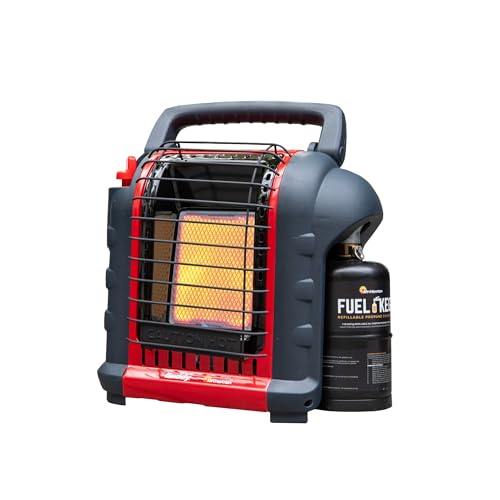
- Emits 4,000 or 9,000 BTU/hr radiant heat
- Designed and approved for indoor and outdoor use
- Heats up to approximately 225 square feet

Pros
-
Indoor-safe design with ODS shutoff
-
Great at warming you, not just the air
-
Compact; easy to store
Cons
-
Meant for small zones, not whole garages
-
Needs ventilation per manual guidance
-
Hose/filter needed for larger tanks
Trade-offs / Who should skip
Skip if you want to heat the entire garage quickly—go forced-air instead.
Scores: Performance 4/5 · Safety Features 5/5 · Ease of Use 4.5/5 · Value 4/5
DeWalt DXH12B (6K/12K BTU) — Best cordless, grab-and-go garage heater
Battery-powered fan/ignition with dual-tank option, built-in LED bar, and USB charging.
Why it wins: Indoor-safe design with ODS, high-speed fan, and 20V MAX/FLEXVOLT battery integration—very handy in a garage or driveway job.
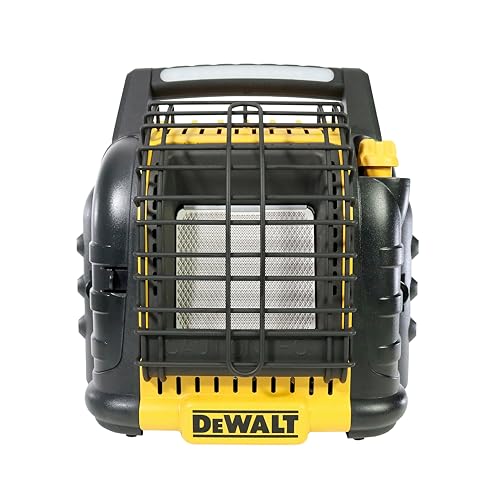
- 3 USB ports for charging personal electronics and accessories
- Powerful LED light bar and integrated high-velocity fan
- High and low heat settings: 12,000 - 6,000 BTUs
Pros
-
Cordless fan/ignition with LED work light
-
ODS and tip-over protection
-
Uses common DeWalt 20V batteries
Cons
-
Lower BTU; best for nearby warmth
-
Battery not always included
-
Regional use limitations in some areas
Trade-offs / Who should skip
Skip if you need to heat the whole garage fast—choose a 30K+ BTU forced-air unit.
Scores: Performance 3.5/5 · Convenience 5/5 · Ease of Use 4.5/5 · Value 4/5
Dyna-Glo RMC-FA60DGD (30–60K BTU) — Best value forced-air alternative
Another proven torpedo heater with continuously variable output and straightforward controls.
Why it wins: Solid 30–60K BTU range, continuous electronic ignition, and construction-heater safety testing.
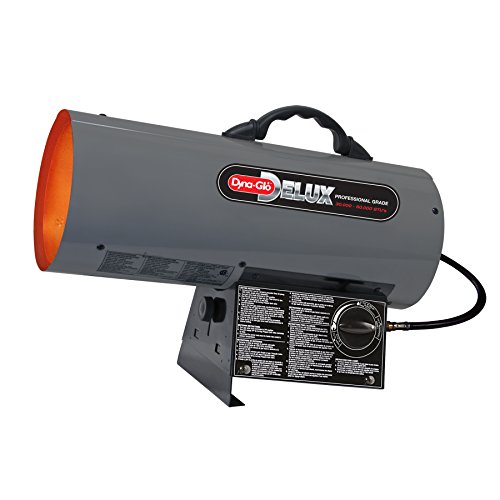
- 30,000 - 60,000 BTUs
- Heats up to 1,350 sq.ft.
- Continuosly Variable BTUs
Pros
-
Variable 30–60K BTU output
-
Clear ventilation guidance in manual
-
Simple to set up with standard LP tanks
Cons
-
Fan noise rises on high—fine for garages
-
Not for living spaces; ventilation required
-
No thermostat
Trade-offs / Who should skip
Skip if you need quieter operation—consider the quieter Mr. Heater above.
Scores: Performance 4.5/5 · Warm-up Speed 5/5 · Ease of Use 4/5 · Value 4.5/5
Mr. Heater Big Maxx MHU50NG (50K BTU) — Best permanent, ceiling-mounted (LP-convertible)
A vented unit heater for true whole-garage comfort—convertible from NG to LP with the correct kit.
Why it wins: Properly vented, thermostat-ready, and sized for typical two- to three-car garages; convert to LP with the manufacturer’s NG→LP kit. Verify kit inclusion on the exact listing.
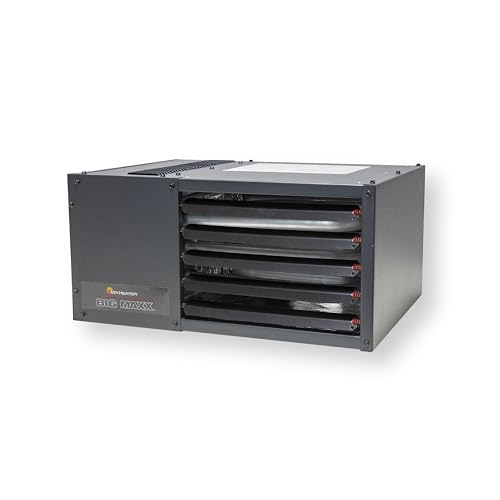
- Ceiling-mounted forced air unit heater turns garages, barns, and workshops into heated workspaces
- 50,000 BTUs heat up to 1,667 sq ft, or approximately a 3-car garage
- Compatible with standard 24-volt or new Wi-Fi enabled thermostats (sold separately)
Pros
-
Vented design for safer whole-garage heat
-
Works with a wall thermostat
-
Clean ceiling mount; keeps floor space clear
Cons
-
Requires venting and proper LP conversion
-
Pro install recommended
-
Kit inclusion varies by retailer
Trade-offs / Who should skip
Skip if you rent or want portable heat; installation and venting add complexity.
Scores: Performance 5/5 · Whole-Space Coverage 5/5 · Ease of Use 3/5 · Value 4/5
Quick compare
-
Mr. Heater MH60QFAV — Best for most garages: Quieter forced-air, 30–60K BTU; still some fan noise.
-
Mr. Heater Buddy MH9BX — Best for spot heat: Indoor-safe radiant; not for whole-space heating.
-
DeWalt DXH12B — Best cordless convenience: Battery-powered fan/LED; lower BTU output.
-
Dyna-Glo RMC-FA60DGD — Best value torpedo: Strong warm-up; louder on high, ventilation needed.
-
Big Maxx MHU50NG — Best permanent setup: Vented, thermostat-ready; LP conversion/installation required.
Buying guide
1) Pick heat style for your use case
-
Forced-air (torpedo): Best for quickly warming the room. Plan on ventilation—these exhaust combustion into the space and need fresh air and clearance.
-
Radiant (Buddy/DXH12B): Best for warming people/objects in a drafty garage; indoor-safe models add ODS/tip-over shutoff. Ventilation is still required per manuals.
-
Ceiling-mounted (vented) unit heater: Best for permanent, whole-garage comfort; follow venting and gas-conversion procedures exactly if running propane (NG→LP kit required).
2) Size the BTUs to the space & insulation
Uninsulated or drafty garages need more BTU. Manufacturer coverage ranges are a good sanity check—aim higher if the door opens often.
3) Safety & placement
-
Keep clearances around outlets, sides, and top as shown in manuals.
-
For wall-mount vent-free heaters in a garage, keep pilot/burner at least 18 inches above the floor and out of vehicle impact zones.
-
Use a CO alarm and provide fresh air as instructed. If a unit mentions “not for living quarters,” treat it as jobsite/garage-only with ventilation.
4) Fuel & runtime
Check the manual’s fuel draw; a 20-lb cylinder can run many hours on low but far fewer at max BTU. In very cold weather, larger cylinders maintain pressure better.
5) Noise
Forced-air units move a lot of air; expect fan noise. Quieter-burner models help, but radiant units remain the quietest nearby.
FAQs
Q: Can I use a propane torpedo heater in a closed garage?
A: Only with the ventilation the manual requires. Construction-style heaters exhaust combustion into the space; provide fresh air and follow clearance rules.
Q: What’s the safest heater style for working right next to it?
A: An indoor-safe radiant model with ODS and tip-over shutoff—still crack the garage door for fresh air.
Q: I want a permanent solution on propane. What do I need?
A: A vented unit heater converted from NG to LP using the correct kit, installed to code with proper venting and a thermostat. Verify whether the kit is included on the exact listing.
As an Amazon Associate, I earn from qualifying purchases.