
Best Audio Interfaces You Can Trust for Years
As an Amazon Associate I earn from qualifying purchases. Some links may earn us a commission at no extra cost to you.
If you’re recording at home, the interface is your front door: clean mic preamps, stable drivers/low latency, and the right I/O make the difference between “eh” and “wow.” Fitment matters too—bus power for laptops/iPad, loopback for streaming, ADAT for growth—and so do warranty and long-term support.
How I researched
I compared late-2025 roundups, deep dives, and official manuals, prioritized driver stability/latency, preamp gain/noise, and monitoring/metering, checked platform fit (macOS/Windows/iPadOS), and noted warranty terms and whether each line is still current. I weighed core recording quality, low-noise gain for dynamics/ribbons, real-world streaming needs (loopback), and growth paths (ADAT, software mixers).
Top picks
Focusrite Scarlett 2i2 (4th Gen) — Best overall for most creators
A rock-solid 2×2 that nails the basics with helpful safety nets (Auto Gain/Clip Safe) and plenty of clean gain.
Why it wins: Great converters, generous mic gain, and Auto Gain/Clip Safe make it forgiving for beginners without holding back more advanced users.

- The new generation of the artist's interface: Connect your mic to Scarlett's 4th Gen mic pres. Plug in your guitar. Fire up the included software. Start making your first big hit
- Studio-quality sound: With a huge 120dB dynamic range, the newest generation of Scarlett uses the same converters as Focusrite’s flagship interfaces, found in the world's biggest studios
- Never lose a great take: Scarlett 4th Gen's Auto Gain sets the perfect level for your mic or guitar, and Clip Safe prevents clipping, so you can focus on the music

Pros
-
Auto Gain + Clip Safe reduce accidental clipping
-
Clean conversion with wide dynamic range
-
Plenty of mic gain for low-output mics
-
3-year manufacturer warranty
Cons
-
No onboard loopback for streaming
-
Two inputs only; no ADAT growth
-
UL/ETL listing couldn’t be verified
Social proof
Widely praised for reliability and ease; see reviews on Amazon.
Trade-offs / Who should skip
If you stream and need built-in loopback, pick the MOTU M2. If you plan to mic a drum kit later, Audient iD14 MkII with ADAT scales better.
Scores: Performance 4.5/5 · Latency & Drivers 4/5 · Ease of Use 4.5/5 · Value 5/5
MOTU M2 — Best for streamers and live creators
Superb meters, loopback, and very low-latency drivers make it ideal for Twitch/YouTube, lessons, and podcasts.
Why it wins: Hardware loopback is built in, the drivers are quick, and the metering is unusually clear for this price.
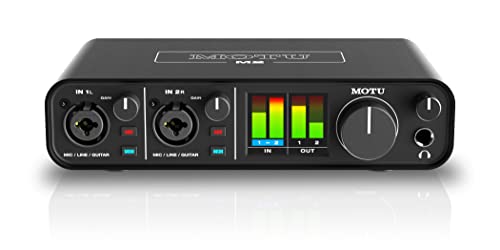
- 6+GB of Free Content - macOS/Windows/iOS
- USB-C Audio Interface with 2 Preamps
- Hardware Monitoring
Pros
-
Built-in loopback for streaming
-
Bright, accurate front-panel meters
-
Clean D/A and headphone output
-
iOS use with proper power
Cons
-
No ADAT for future inputs
-
Blend control is software-side
-
UL/ETL listing couldn’t be verified
Social proof
Commonly recommended by streamers for stability; see reviews on Amazon.
Trade-offs / Who should skip
If you’ll expand beyond two inputs, consider Audient iD14 MkII. Need premium mixer/routing? RME Babyface Pro FS is stronger.
Scores: Performance 4.5/5 · Latency & Drivers 4.5/5 · Ease of Use 4/5 · Value 4.5/5
Universal Audio Volt 276 — Best for vocals and podcasts (analog compression)
A 2×2 with UA’s “Vintage” mic pre mode and an analog 1176-style compressor that flatters voices on the way in.
Why it wins: The 76 Compressor and Vintage Preamp give vocal tracks polish without plugins; it also works with Mac/PC and iPad/iPhone (with proper power).

- Enjoy the rich, album-ready sound of classic UA 610 preamps with Vintage mode
- Add clarity and punch to vocals, instruments, and more with an analog compressor based on the renowned 1176
- Record and mix with the award-winning LUNA Digital Audio Workstation, giving you the sound and workflow of a real analog studio
Pros
-
Analog 1176-style compressor onboard
-
“Vintage” preamp color option
-
iPad/iPhone capable with power
-
Handy direct monitoring
Cons
-
No loopback for streaming
-
Color is on/off, not per-band
-
UL/ETL listing couldn’t be verified
Social proof
Often praised by podcasters for vocal tone; see reviews on Amazon.
Trade-offs / Who should skip
If you prefer totally transparent capture, choose Focusrite or Audient. If you stream games/calls, the MOTU M2’s loopback is simpler.
Scores: Performance 4/5 · Latency & Drivers 3.5/5 · Ease of Use 4/5 · Value 4/5
Audient iD14 MkII — Best small studio interface for growth (ADAT)
Compact now, expandable later—add up to 8 mic channels over ADAT when you need them.
Why it wins: Two excellent Audient console preamps, JFET DI, and ADAT input add real upgrade headroom for drums or full bands.

- The new successor: Due to the great success of the Audient iD14, the audio experts had the project to bring the successor iD14 MKII to the next outstanding sonic level.
- Harmonious overall package: Thanks to new transducer technology and two Class-A microphone preamps from Audient's high-end ASP8024 HE console, home recording is taken to the next level.
- New connector: The new Audient iD14 MKII now has a high-speed USB-C connector, so handling is easier and power supply is improved! Finally, no more multiple cables!
Pros
-
ADAT input adds eight channels later
-
Clean console-grade preamps
-
JFET DI flatters guitar/bass
-
3-year manufacturer warranty
Cons
-
No built-in loopback
-
Only two analog inputs onboard
-
UL/ETL listing couldn’t be verified
Social proof
Well-reviewed for sound quality and ergonomics; see reviews on Amazon.
Trade-offs / Who should skip
If you’ll never expand past two inputs, Focusrite/MOTU may be simpler. If you want deep routing/FX, RME is stronger.
Scores: Performance 4.5/5 · Latency & Drivers 4/5 · Ease of Use 4/5 · Value 4.5/5
RME Babyface Pro FS — Best premium / pro longevity pick
Portable, impeccably engineered, with TotalMix FX and driver support that tends to outlast computers.
Why it wins: RME’s drivers and TotalMix FX are the standard for stability/routing, with class-compliant mode and DC-coupled outputs for synth/CV workflows.

- USB 2.0 Audio Interface with 2 Preamps
- Plug-in Bundle - macOS/Windows/iOS
- 24-bit/192kHz
Pros
-
TotalMix FX routing/mixing flexibility
-
Extremely stable low-latency drivers
-
Class-compliant iPad mode
-
DC-coupled outputs for synth/CV
Cons
-
Premium price tier
-
Learning curve for TotalMix FX
-
UL/ETL listing couldn’t be verified
Trade-offs / Who should skip
If you don’t need advanced routing or ultra-low latency, the MOTU/Focusrite choices save money. If vocals-first tone shaping is priority, UA Volt 276 fits.
Scores: Performance 5/5 · Latency & Drivers 5/5 · Ease of Use 4/5 · Value 4/5
Quick compare
-
Focusrite Scarlett 2i2 (4th Gen) — Best for most: Auto Gain/Clip Safe, generous gain; no loopback.
-
MOTU M2 — Best for streaming: Built-in loopback and fast drivers; no ADAT growth.
-
UA Volt 276 — Best for vocals/podcasts: Vintage pre + analog 1176-style comp; no loopback.
-
Audient iD14 MkII — Best to grow a studio: ADAT input for eight more pres; compact today.
-
RME Babyface Pro FS — Best premium: Elite drivers and routing; higher learning curve.
Buying guide
- Drivers & latency: If you’ll monitor through the DAW or do live streams, drivers matter. RME and MOTU are standouts; Focusrite’s 4th-gen drivers are solid for music production. Pick loopback (MOTU) if you route Zoom/Discord/game audio.
- Preamps & gain: Low-output mics like SM7B appreciate higher gain. Focusrite’s generous gain helps; Audient’s console pres are clean and punchy; UA’s “Vintage” mode adds color when desired.
- I/O & expansion: Two inputs are enough for solo work. If you foresee drums or multi-mic sessions, choose an interface with ADAT (Audient iD14 MkII) to add eight pres later.
- Platform fit: iPad/iPhone recording? MOTU M2 and UA Volt support iOS when powered properly. macOS/Windows support is standard across picks.
- Monitoring & metering: Clear front-panel meters (MOTU) help set levels; Focusrite’s Clip Safe provides a safety net if you miss.
- Warranty & support: Focusrite and Audient offer 3-year warranties; MOTU and RME list 2-year terms; UA publishes detailed policy info.
FAQs
Q: Do I need an external preamp for a Shure SM7B?
A: Not necessarily. The Scarlett 2i2 (4th Gen) has generous gain and will drive many dynamics; if you record very softly, a clean inline booster can help.
Q: Which interface is best for Zoom/OBS streaming?
A: The MOTU M2 thanks to built-in loopback; it routes system audio + mic to your stream without extra software.
Q: Can I record to an iPad/iPhone?
A: Yes—MOTU M2 and UA Volt 276 support iOS as class-compliant devices; use the proper Apple adapter and a powered USB hub if needed.
Q: What if I’ll need more than two mic inputs later?
A: Get Audient iD14 MkII now and add an 8-channel preamp over ADAT when you’re ready.
As an Amazon Associate, I earn from qualifying purchases.