
Best Point and Shoot Camera
As an Amazon Associate I earn from qualifying purchases. Some links may earn us a commission at no extra cost to you.
Looking for a simple, pocketable camera that beats your phone? The big things that matter are sensor size (low-light quality), lens speed/zoom (what you can shoot), stabilization (sharper photos, smoother video), and reliability/warranty. Ergonomics and battery life matter too—especially for travel.
How I researched
I compared late-2025 hands-on reviews and spec sheets, prioritized real-world image quality (especially low light), autofocus reliability, stabilization, and lens range/speed. I checked fit/compatibility (charging, memory, mic inputs), and noted which models are current vs. near-EOL. I weighed image quality, AF/video features, ruggedness, and long-term ownership (support/warranty). This guide favors models with clear manufacturer documentation and current U.S. availability.
Top picks
Sony RX100 VII — Best for overall pocket performance
The tiny camera that still feels pro: great photos, fast AF, 4K video, and a versatile 24–200mm zoom in your pocket.
Why it wins: Class-leading autofocus and a long 1″-sensor zoom lens make it the most complete “do-everything” compact.
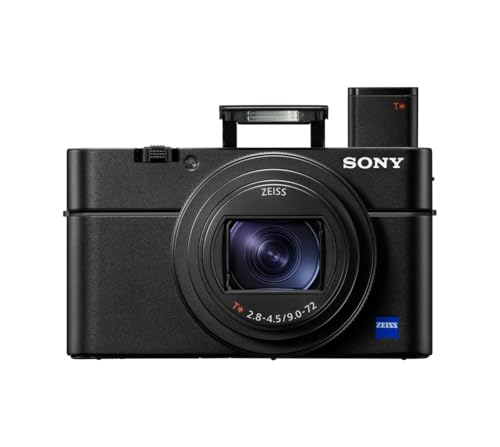
- 20. 1MP 1. 0 Type stacked CMOS sensor, Zeiss Vario Sonnar T 24 200 millimeter F2. 8 F4. 5 large aperture high magnification zoom lens
- 0. 02 sec. High AF speed, 357 point focal plane Phase detection AF and 425 point contrast detection AF
- Up to 20 fps blackout free shooting, using up to 60 times/sec. AF/AE calculations. Diopter Adjustment: -4.0 to +3.0 m-1. Operating Temperature- 0 degrees C.- +40 degrees C. / 32 degrees F. - 104 degrees F

Pros
-
Excellent autofocus/tracking for people and pets
-
Sharp 24–200mm equivalent zoom range
-
1″ sensor beats phone low-light shots
-
Pop-up EVF for bright-sun framing
Cons
-
Lens is slower than f/1.8 rivals
-
Menu system takes learning
-
Not ideal if you want a big grip
Social proof
Reviewers still praise its AF and versatility; if you want one camera for everything, this is it. See reviews on Amazon.
Trade-offs / Who should skip
Skip if you prioritize wide, selfie-friendly video tools (see the ZV-1 II) or need extreme durability (see TG-7).
Scores: Performance 4.8/5 · AF & tracking 5/5 · Ease of Use 3.5/5 · Value 3.5/5
Sony ZV-1 II — Best for vlogging & YouTube
A pocket vlog camera with a truly wide 18–50mm lens, strong built-in mic, and creator-friendly shortcuts.
Why it wins: The 18mm wide end, flip screen, Product Showcase, and 3-capsule mic make framing/talking to camera effortless.

- Ultra-wide 18-50mm1 zoom lens gets it all in the frame
- Large 1.0-type sensor for professional results even in low-light
- Wide aperture F1.8-4.0 lens for beautifully defocused backgrounds
Pros
-
Ultra-wide 18mm for arm’s-length shots
-
Directional 3-capsule mic with windscreen
-
One-tap background blur & Product Showcase
-
1″ sensor with 4K video options
Cons
-
No viewfinder; screen only
-
Not for distant subjects; short zoom
-
Stabilization is modest while walking
Trade-offs / Who should skip
Skip if you want telephoto reach or a viewfinder; consider RX100 VII for reach or ZS99 for budget travel zoom.
Scores: Performance 4.4/5 · Video tools & audio 4.7/5 · Ease of Use 4.8/5 · Value 4.2/5
Panasonic LUMIX ZS99 — Best travel zoom (30× pocket super-zoom)
A true pocket “go anywhere” camera with 24–720mm reach, tilt touchscreen, USB-C charging, and 4K photo/video.
Why it wins: Massive 30× zoom with traveler-friendly features and modern connectivity in a compact body.

- The Powerhouse Pocket Camera You've Been Looking For: Small camera with 24-720mm LEICA lens with 30x Zoom and compact body that slips in your pocket; the ZS99 is ready to shoot everything from sweeping landscapes to favorite moments with incredible detail
- 4K Video and Photo for Bright, Sharp Images: Relive your favorite moments in high-quality 4K video at 30p or capture quick bursts of 4K PHOTO at 30fps with our 4k digital camera; HD high-speed video at 120fps for creative flexibility in slow-motion shots
- Portable Camera to Shoot on the Go: Shoot from any angle with ease, with the 1,840k-dot tiltable touchscreen; this small digital camera features universal USB Type-C charging that ensures you’re always powered up to capture life moments
Pros
-
24–720mm 30× zoom in pocket size
-
USB-C charging; handy on trips
-
4K photo modes for action moments
-
Tilting 1.84M-dot touchscreen
Cons
-
1/2.3″ sensor; low-light is limited
-
No viewfinder on this model
-
Sharpest mid-zoom; wide end can soften
Trade-offs / Who should skip
Skip if your priority is night/indoor image quality—choose a 1″-sensor model (RX100 VII/G7 X III).
Scores: Performance 4.1/5 · Reach & stabilization 4.5/5 · Ease of Use 4.4/5 · Value 4.3/5
OM SYSTEM Tough TG-7 — Best for beaches, slopes, and underwater
Shockproof, crushproof, freezeproof—and waterproof to 50 ft—yet still shoots RAW, 4K, and killer macro.
Why it wins: It’s the rugged compact that truly survives adventures and nails close-ups phones can’t touch.

- Waterproof 15 meters (50 feet), Dustproof, Shockproof 2.1 meters (7 feet), Crushproof 100 kilogram-force (220 pound-force), Freezeproof -10 °C (14 °F), Anti-fog
- High resolution F2.0 lens, maximum 4x zoom, true pic VIII, back illuminated CMOS image sensor
- Variable macro system comprised of 4 macro modes, magnified capturing up to 1 centimeter from the end of the lens
Pros
-
Waterproof to 15 m; no housing needed
-
Macro “microscope” modes are outstanding
-
Cold-proof, crush-proof, drop-resistant
-
USB-C and 4K video support
Cons
-
1/2.3″ sensor; best outdoors/daylight
-
25–100mm reach; limited telephoto
-
Color grading latitude is modest
Trade-offs / Who should skip
Skip if your priority is low-light portraits or background blur—choose a 1″ compact instead.
Scores: Performance 4.0/5 · Ruggedness & macro 5/5 · Ease of Use 4.5/5 · Value 4.4/5
Canon PowerShot G7 X Mark III — Best for low-light portraits & compact creators
A bright-lens 1″ compact with a flip screen and mic jack—great for travel portraits and clean, simple video.
Why it wins: The f/1.8–2.8 lens and 1″ sensor deliver nicer indoor/low-light photos than small-sensor compacts.

- 20.1 Megapixel 1.0” stacked CMOS sensor and DIGIC 8 Image processor.
- 4.2x optical zoom Lens (24-100mm f/1.8-2.8) with optical image Stabilizer.
- 4K 30P/ FHD 120P video.
Pros
-
Bright f/1.8–2.8 lens for low light
-
1″ stacked sensor; RAW stills, 4K video
-
Flip screen and 3.5mm mic input
-
Pocketable, creator-friendly controls
Cons
-
No viewfinder; screen-only framing
-
AF is good; not Sony-level sticky
-
Older model; stock can fluctuate
Trade-offs / Who should skip
Skip if you need long zoom reach—consider the ZS99—or if you want best-in-class AF—go RX100 VII.
Scores: Performance 4.2/5 · Low-light rendering 4.6/5 · Ease of Use 4.5/5 · Value 4.0/5
Quick compare
-
RX100 VII — Best for overall: 1″ sensor + 24–200mm + elite AF; smaller grip, learning curve.
-
ZV-1 II — Best for vlogging: 18mm wide, great mic, creator modes; short zoom, no EVF.
-
LUMIX ZS99 — Best travel zoom: 30× reach, USB-C, 4K; small sensor, no EVF.
-
OM SYSTEM TG-7 — Best rugged: waterproof, shockproof, amazing macro; limited tele, smaller sensor.
-
Canon G7 X III — Best low light portraits: fast lens, mic jack; older model, screen-only.
Buying guide
-
Sensor size: 1″ sensors (RX100 VII, G7 X III) deliver cleaner low-light photos and nicer background blur than 1/2.3″ travel/rugged cams (ZS99, TG-7). Choose 1″ if you shoot indoors or at night.
-
Lens & reach: If you want wildlife, stadiums, or distant cityscapes, pick a long zoom (ZS99’s 24–720mm). For portraits and casual travel, a shorter, brighter lens (G7 X III) looks better.
-
Autofocus & video: For moving subjects or hybrid stills/video, the RX100 VII’s AF is the most dependable; for creator-friendly tools and a wide selfie view, the ZV-1 II is easier.
-
Ruggedness: Need something beach/snow/underwater-proof without a housing? That’s the TG-7. Expect flatter low-light performance versus 1″ models.
-
Viewfinder vs. screen: If you shoot in bright sun, the RX100 VII’s EVF helps. The ZV-1 II, ZS99, TG-7, and G7 X III are screen-only.
-
Charging & convenience: USB-C charging is especially handy on the road (ZS99, TG-7).
FAQs
Q: What’s the simplest upgrade over my phone for family trips?
A: If you want a true “phone-plus” with zoom, the Panasonic ZS99 is the easiest to live with thanks to its 30× lens and USB-C charging. For nicer indoor portraits, step up to a 1″ compact like the Canon G7 X III.
Q: Do I need a viewfinder on a point-and-shoot?
A: Not strictly, but it helps in bright sun. The RX100 VII includes a pop-up EVF; the others here are screen-only. If you shoot lots of daytime travel scenes, that EVF can be worth it.
As an Amazon Associate, I earn from qualifying purchases.