
Digital Cameras for Beginners
As an Amazon Associate, I earn from qualifying purchases. Some links may earn us a commission at no extra cost to you.
If you’re just getting started, the big wins are easy, reliable autofocus, a lens ecosystem you can grow into, and controls that don’t overwhelm you. Battery life and an EVF (electronic viewfinder) also matter once you move beyond phone shooting.
How I researched
I compared late-2025 camera roundups, deep dives, and lab tests, prioritized beginner-friendly autofocus and ergonomics, checked mount ecosystems (RF/RF-S, E-mount, Z-mount, X-mount) and lens availability, and noted warranty terms and any signs of discontinuation. I weighed image quality, AF tracking, battery ratings (CIPA), video capability, and ownership basics (size, menus, learning curve). This guide sticks to current US variants and links standard kits (no third-party bundles).
Top picks
Canon EOS R50 — Best for most beginners
Canon’s easiest “real camera” jump-off: great AF, 4K, and a tiny body you’ll actually carry.
Why it wins: Canon’s Dual Pixel AF is super sticky, and the RF-S mount has solid starter lenses.

- High Image Quality: Canon EOS R50 4K digital camera features a 24.2 Megapixel CMOS (APS-C) sensor and DIGIC X processor for stunning image clarity and level of detail
- High-Speed Continuous Shooting: Capture fast action with up to 12 fps with Electronic First Curtain shutter and up tp 15 fps with Electronic Shutter for a superior vlogging camera
- Advanced Auto Focus: Dual Pixel CMOS AF II covers up to 100% x 100% area with 651 AF zones; features auto subject detection and tracking of people, animals, and vehicles using deep learning technology — perfect 4K camera for video recording
Pros
-
Dual Pixel AF is beginner-friendly
-
Oversampled 4K/30 looks crisp
-
Light: very portable body
-
Guided modes help you learn
Cons
-
No in-body stabilization
-
EVF is good, not huge
Social proof
Reviewers consistently praise autofocus and ease of use; see rating & reviews on Amazon.
Trade-offs / Who should skip
If you want IBIS for low-light handheld video, look to Fujifilm X-T50 instead.
Scores: Performance 4.5/5 · Autofocus 4.5/5 · Ease of Use 5/5 · Value 4.5/5
Sony ZV-E10 II — Best for video-first creators
Purpose-built for creators with simple video tools, strong battery life, and Sony’s huge E-mount lens pool.
Why it wins: Upgraded sensor and long-lasting NP-FZ100 battery make it a stress-free hybrid for beginners.

- Exmor R CMOS sensor: The ZV-E10 II features Sony's most advanced sensor technology in an APS-C back-illuminated Exmor R CMOS image sensor with approximately 26 megapixels. Compared to other cameras, the image sensor of the ZV-E10 II is approximately ten times bigger than the average smartphone sensor and three times bigger than a premium 1-type (1-inch) sensor found in compact cameras, allowing for beautiful, professional-looking images with high resolution and intricate detail.
- Interchangeable lenses to capture your vision : From the G Master series, which blends breathtaking resolution with exquisite bokeh, to the G Lens series with first-class image quality, the ZV-E10 II is compatible with a wide range of E-mount lenses from Sony. The ZV-E10 II lens kit comes with the versatile E PZ 16-50mm F3.5-5.6 OSS II zoom lens.
- Create your look in camera: The Creative Look function makes it simple to create expressive moods for stills and movies in-camera, offering 10 presets that can be used as they are or customized. Try the My Image Style function for further expressive versatility. When shooting in the Intelligent Auto or Scene Selection mode, it allows the background bokeh, brightness, and color tone to be easily adjusted via icons on the touch screen.
Pros
-
Reliable video autofocus
-
Long battery life for its class
-
Flip screen and creator shortcuts
-
Massive E-mount lens selection
Cons
-
No EVF; LCD-only framing
-
No in-body stabilization
Social proof
Creator reviews call it the easiest path to “YouTube-ready” footage; see rating & reviews on Amazon.
Trade-offs / Who should skip
If you want an EVF for bright-sun stills, consider Nikon Z50 II instead.
Scores: Performance 4.5/5 · Autofocus 4.5/5 · Ease of Use 4.5/5 · Value 4.5/5
Nikon Z50 II — Best for beginners who want an EVF and classic handling
A friendly body with a real viewfinder, solid stills, and approachable menus.
Why it wins: Adds faster bursts and modern subject detection while keeping Nikon’s comfy grip.

- Go Beyond Your Phone: Capture lifelike colors and incredible details from dawn to dusk thanks to a superior 20.9-megapixel DX format (APS-C size) sensor several times larger than that of a typical smartphone, but still lightweight and compact enough to fit in a small bag.
- Find Your Aesthetic: At the press of the Picture Control button, choose from 31 built-in presets designed to make your photos and videos stand out. Create and save your own Picture Control presets or download bespoke Cloud Picture Controls directly to your Z50II from Nikon Imaging Cloud. Play with results in real-time as you shoot and open up a world of creative possibilities.
- Focus with Confidence: People, dogs, cats, birds and vehicles—the Z50II can automatically detect and accurately track nine distinct subjects. Plus dedicated bird and airplane modes for even greater autofocus accuracy.
Pros
-
Comfortable EVF for learning exposure
-
Subject-detect AF for people/animals
-
Good JPEG color out of camera
-
Z-mount has affordable DX zooms
Cons
-
No in-body stabilization
-
Battery rating is modest (CIPA)
Social proof
Owners highlight handling and color; see rating & reviews on Amazon.
Trade-offs / Who should skip
If handheld video is priority #1, Sony ZV-E10 II’s screen tools are friendlier.
Scores: Performance 4/5 · Autofocus 4/5 · Ease of Use 4.5/5 · Value 4/5
Fujifilm X-T50 — Best for beautiful JPEGs and “learn by dials”
A tactile, film-style body with Film Simulation dial and in-body stabilization that flatters handheld shooting.
Why it wins: The high-resolution sensor plus IBIS deliver sharp, color-rich results without heavy editing.

- Dedicated Film Simulation dial offering fast access to 20 Film Simulations (including REALA ACE mode)
- 40.2-megapixel X-Trans CMOS 5 HR sensor
- Supports all X Series lenses and includes a 1.4x and 2x Digital Teleconverter
Pros
-
40MP-class detail with lovely Fuji color
-
5-axis IBIS steadies low-light shots
-
Film Sim dial encourages learning
-
Compact with EVF
Cons
-
Single card slot
-
Menus feel different to newcomers
Social proof
Reviewers praise its JPEGs and stabilization; see rating & reviews on Amazon.
Trade-offs / Who should skip
If you prefer deep video tools and creator features, Sony ZV-E10 II fits better.
Scores: Performance 4.5/5 · Autofocus 4/5 · Ease of Use 4/5 · Value 4/5
Canon EOS R100 — Best budget starter
The cheapest doorway into Canon RF with a straightforward feature set.
Why it wins: 24MP APS-C sensor, Canon color, and a tiny body for true beginners on a budget.
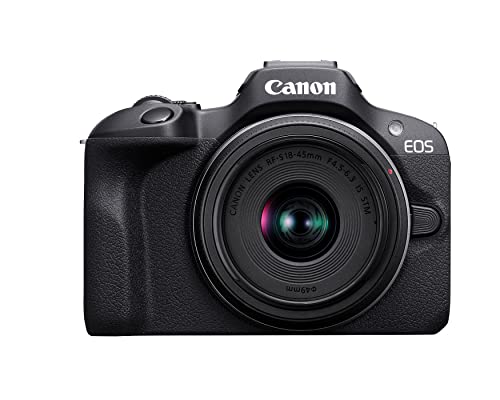
- Stellar Image Quality: Canon EOS R100 4K digital camera with 24.1 megapixel CMOS (APS-C) sensor for superb image clarity and detail can capture images with natural bokeh
- Compact Design: Compact, lightweight EOS R series 4K camera with an affordable price; smallest and lightest camera body in the EOS R series built for excellent mobility
- Powerful Image Processor: DIGIC 8 image processor allows for improved shooting functionality and 4K video capability; EOS R100 is a great starting point for users looking for mirrorless cameras with interchangeable lenses
Pros
-
Very compact and light
-
Canon color with simple auto modes
-
Entry to RF/RF-S lenses
Cons
-
4K has notable limitations
-
AF and controls are basic
Social proof
Beginners like the size and simplicity; see rating & reviews on Amazon.
Trade-offs / Who should skip
If you’ll shoot a lot of video or moving subjects, step up to R50.
Scores: Performance 3.5/5 · Autofocus 3.5/5 · Ease of Use 4.5/5 · Value 4/5
Quick compare (table-free)
-
Canon EOS R50 — Best for most: sticky AF, crisp 4K/30, very light; no IBIS.
-
Sony ZV-E10 II — Best for video-first: creator UI, long battery, huge lens pool; no EVF.
-
Nikon Z50 II — Best handling + EVF: comfy grip, subject detect; modest battery rating, no IBIS.
-
Fujifilm X-T50 — Best JPEG color/learning by dials: high-res sensor + IBIS, Film Sims; single card slot.
-
Canon EOS R100 — Best budget: smallest RF starter; pared-back video/AF vs R50.
Buying guide
Decide by autofocus and viewfinder. If you’ll chase kids/pets, Canon’s Dual Pixel AF (R50) or Sony’s reliable AF (ZV-E10 II) make learning easy. Prefer an EVF for bright sun and exposure feedback? Pick Nikon Z50 II or Fujifilm X-T50.
Video priorities. If YouTube/TikTok is the goal, ZV-E10 II’s flip screen and creator-first controls are the easiest on-ramp. R50’s oversampled 4K/30 is great for general hybrid use; X-T50 adds IBIS to steady handheld clips.
Battery life. If you’ll shoot long days, ZV-E10 II’s NP-FZ100 battery is a standout among beginner bodies. Nikon Z50 II’s CIPA rating is lower; plan on a spare.
Lens ecosystem and growth.
-
Canon RF/RF-S: growing native RF-S zooms and primes; full-frame RF is there when you upgrade.
-
Sony E-mount: widest third-party support and many affordable primes/zooms.
-
Nikon Z: good starter DX zooms and solid roadmap; easy step-up to full-frame Z.
-
Fujifilm X: excellent small primes, great JPEG color workflow.
Warranty & safety. Most major brands offer a standard 1-year limited warranty in the US. UL/ETL safety listings aren’t typical for camera bodies; if that matters to you, check the product documentation before buying.
Fit/feel matters. If possible, try the grip and menu logic in person—small bodies (R50, R100) are super portable, while Z50 II and X-T50 feel more “camera-like” in hand.
As an Amazon Associate, I earn from qualifying purchases.