
5 Best Whole House Generators — Keep Everything Running When the Grid Fails
As an Amazon Associate I earn from qualifying purchases. Some links may earn us a commission at no extra cost to you.
A generator capable of powering a whole house needs to output at least 7,500 running watts to cover essential circuits — HVAC, refrigerator, lights, and electronics simultaneously. The five below are the portable generators in the 8,000–13,500 watt range that can realistically serve as whole-house backup power without requiring a permanent standby installation.
I reviewed output capacity, fuel efficiency, dual-fuel flexibility, noise ratings, and long-term owner reliability reports to identify the options that deliver dependable whole-house backup power during extended outages.
DuroMax XP13000EH 13,000-Watt Dual Fuel Generator — Best Overall Whole House Generator
The DuroMax XP13000EH delivers 10,500 running watts and 13,000 peak watts on gas, or 8,000+ running watts on propane — enough to power central air conditioning, a refrigerator, lights, and most household electronics simultaneously. Why it wins: EPA and CARB certification for all 50 states, a 500cc OHV engine with cast iron sleeve for long-term durability, and CO Alert automatic shutdown make the XP13000EH the most capable and safest whole-house portable generator available without stepping into dedicated standby territory.

- With 13,000 watts of power, the XP13000EH Dual Fuel generator will keep your whole home running during a storm or power outage
- DuroMax is the industry leader in Dual Fuel portable generator technology, with a full assortment ranging from digital inverters to generators that can power your entire home
- At the core of all our products resides a robust DuroMax engine. Designed for Power. Designed to Last

Pros
- 13,000 peak / 10,500 running watts handles central A/C plus full household load simultaneously
- Dual fuel (gasoline or propane) — propane doesn’t degrade in storage, critical for emergency preparedness
- CO Alert automatic shutdown triggers if carbon monoxide reaches unsafe levels — a critical safety feature
Cons
- Heavy unit — requires the included wheel kit and two people to move; this is not a casual portable generator
- 74 dBA noise level — louder than inverter generators; expect significant noise during operation
See rating & reviews on Amazon.
Trade-offs / Who should skip
Users who want quiet operation for neighborhood-sensitive locations should choose the Champion 100520 inverter generator instead. The DuroMax XP13000EH is the right choice when maximum power output is the priority — it’s the only generator on this list that can power central A/C systems above 4 tons without straining.
Scores: Power Output 5/5 | Dual Fuel 5/5 | Noise Level 2.5/5 | Value 4.5/5
Westinghouse WGen9500DF 12,500-Watt Dual Fuel Generator — Best Westinghouse Whole House Generator
The Westinghouse WGen9500DF produces 9,500 running watts and 12,500 peak watts on gas — powered by a 457cc 4-stroke OHV engine with a cast iron sleeve, remote key fob start, and a transfer switch-ready 50-amp outlet. Why it wins: Westinghouse’s 3-year warranty and lifetime technical support are among the strongest service commitments in the portable generator category — important for emergency equipment you need to work reliably when you need it most.

- 9500 Running Watts and 12500 Peak Watts (Gasoline); 8500 Running Watts, 11200 Peak Watts (Propane); Remote Start with Included Key Fob, Electric and Recoil Start; Up to 12 Hours of Run Time on a 6. 6 Gallon Fuel Tank with Fuel Gauge
- Features Two GFCI 120V 5–20R 20A Standard Household Receptacle, One Transfer Switch Ready 120V L14-30R 30A, and One RV Ready 120/240V 14–50R 50A; All Outlets Have Rubber Covers for Added Safety
- Powered by a Heavy Duty 457cc Westinghouse 4-Stroke OHV Engine Featuring a Long-Lasting Cast Iron Sleeve with Automatic Low Oil Shutdown and Digital Hour Meter. VFT display gives you real time updates with the voltage output, frequency, and lifetime hours
Pros
- Remote key fob start allows you to start the generator from a distance — critical in severe weather conditions
- Transfer switch-ready 50-amp outlet enables proper whole-house backup via a manual transfer switch
- 3-year warranty with lifetime technical support — among the strongest service commitments in this category
Cons
- 74 dBA at 23 feet — similar noise level to the DuroMax and other large conventional generators
- 6.6-gallon tank provides only 12 hours at 50% load — requires frequent refueling during extended outages
See rating & reviews on Amazon.
Trade-offs / Who should skip
Users who need maximum running wattage over the WGen9500DF’s 9,500W capacity should choose the DuroMax XP13000EH. The Westinghouse is the right choice when the combination of remote start convenience, transfer switch readiness, and Westinghouse’s service reputation matters more than peak power output.
Scores: Power Output 4.5/5 | Dual Fuel 5/5 | Noise Level 2.5/5 | Value 4.5/5
Champion 8500W Dual Fuel Inverter Generator — Best Quiet Whole House Option
Champion’s 8,500-watt dual fuel inverter generator combines whole-house-capable power output with inverter technology that keeps noise at 69 dBA — significantly quieter than conventional frame generators at comparable wattage. Why it wins: Inverter technology produces cleaner power that’s safe for sensitive electronics, and at 69 dBA it’s meaningfully quieter than non-inverter alternatives — a real difference in neighborhood tolerance during multi-day outages.

- Operate your 8500-watt portable generator right out of the box on either gasoline or propane, plus features CO Shield carbon monoxide auto shutoff system plus the EZ Start Dial simplifies startup
- 61 dBA is great for RVs, tailgating, or camping with 8500 starting watts, 7000 running watts and up to 14 hours run time on gasoline, and 6300 running watts and up to 12 hours on propane
- Power up the 420cc Champion engine with the handy rocker switch (battery included) and use Intelligauge to monitor voltage, frequency and operating hours with ease
Pros
- Inverter technology produces clean sine wave power safe for computers, medical equipment, and sensitive electronics
- 69 dBA noise level — quieter than conventional frame generators at comparable wattage
- CO Shield automatic CO shutdown adds a safety layer that older champion models lacked
Cons
- 8,500 watts may not cover central A/C systems larger than 3 tons alongside full household load
- Inverter generator cost premium is higher than equivalent conventional generators at this wattage
See rating & reviews on Amazon.
Trade-offs / Who should skip
Users with large central A/C systems (4+ ton) or heavy appliance loads need the higher output of the DuroMax or Westinghouse. The Champion 8500W inverter is the right choice for homes with moderate AC systems where cleaner power, quieter operation, and CO safety are higher priorities than maximum wattage.
Scores: Power Output 4/5 | Dual Fuel 5/5 | Noise Level 4/5 | Value 4/5
Champion 100520 8750-Watt Open Frame Inverter Generator — Quietest High-Power Generator
Champion’s 100520 is an open-frame inverter generator that achieves 8,750 peak watts and 7,000 running watts while maintaining quieter operation than conventional frame generators — and parallel capability lets you connect two units to double the output. Why it wins: Champion’s 420cc engine with inverter technology in the open-frame format is 30% quieter than traditional 7,000-watt generators — the best balance of power and noise management in Champion’s lineup.
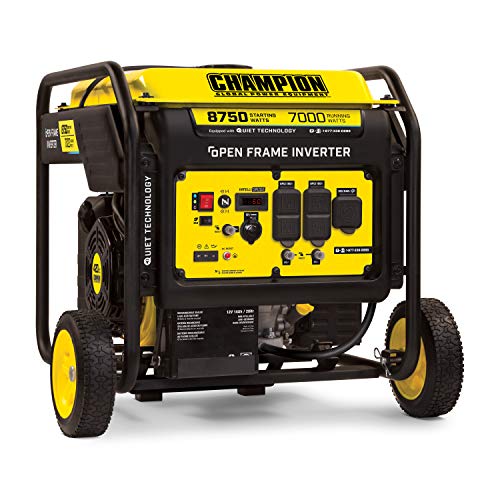
- Advanced Open Frame Inverter Design: 30% quieter and 25% lighter than a traditional Champion 7000-watt generator, plus this inverter only produces Clean Power, and Economy Mode saves fuel
- Electric Start: The convenient electric push-button start includes a battery
- Quiet Technology and Extended Run Time: 72 dBA is great for your next project or home backup, with 8750 starting watts and 7000 running watts for up to 10. 5 hours run time on gasoline
Pros
- Open-frame inverter design is 30% quieter than traditional generators at equivalent wattage
- Parallel capability — connect two units via parallel kit for up to 14,000 running watts if needed
- 120/240V L14-30R outlet with transfer switch compatibility for proper whole-house wiring
Cons
- Gasoline-only — no dual fuel capability unlike the other Champion options on this list
- 7,000 running watts is the smallest capacity on this list — borderline for whole-house coverage with A/C
See rating & reviews on Amazon.
Trade-offs / Who should skip
Users who want propane capability for long-term fuel storage should choose the Champion 8500W dual fuel or Westinghouse WGen9500DF instead. The Champion 100520 is the right choice when quiet operation is the primary priority and you’re comfortable with gasoline-only fueling.
Scores: Power Output 3.5/5 | Dual Fuel 1/5 | Noise Level 4.5/5 | Value 4/5
Champion 8000-Watt Dual Fuel Portable Generator — Best Budget Whole House Generator
Champion’s 8,000-watt dual fuel generator delivers 6,500 running watts on gas or 5,500 on propane at the most accessible price point for a dual-fuel generator capable of running essential whole-house circuits. Why it wins: For smaller homes or households that prioritize essential circuits over whole-house coverage, the Champion 8000 delivers dual-fuel reliability and electric start at a price point that makes it accessible as a preparedness purchase rather than a premium investment.
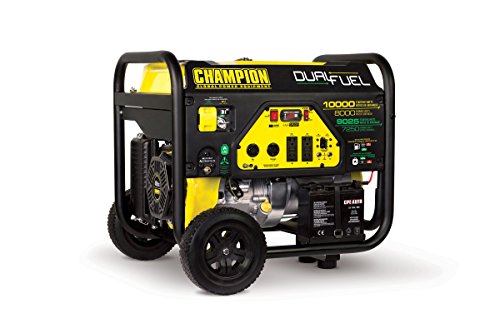
- Dual Fuel – Operate your 8000-watt portable generator right out of the box on either gasoline or propane, plus the unit holds 1.2-quarts of oil (included) and has a low oil shut-off sensor
- Electric start – Power up the 459cc Champion engine with the handy toggle switch, battery included
- Intelligauge – Keep track of voltage, hertz and run-time hours to easily monitor power output and track maintenance intervals
Pros
- Dual fuel (gas and propane) flexibility for fuel choice during extended outages when gas stations have queues
- Electric start with battery included — no pull cord required in emergency situations
- Champion’s 3-year warranty with FREE lifetime technical support included with purchase
Cons
- 6,500 running watts is the lowest capacity on this list — limited when running A/C plus full household load
- Older design without CO Shield — manually monitoring carbon monoxide is required during operation
See rating & reviews on Amazon.
Trade-offs / Who should skip
Larger homes or homes with central A/C should step up to the 9,500–13,000 watt options. The Champion 8000 is the right choice for smaller homes where running essential circuits (refrigerator, lights, a window A/C unit) is sufficient backup coverage and cost is a primary consideration.
Scores: Power Output 3.5/5 | Dual Fuel 5/5 | Noise Level 3/5 | Value 5/5
Quick Compare
- Best maximum power whole house coverage: DuroMax XP13000EH
- Best Westinghouse with remote start: Westinghouse WGen9500DF
- Best quiet whole house generator: Champion 8500W Dual Fuel Inverter
- Quietest high-power option: Champion 100520 8750W Open Frame Inverter
- Best budget dual fuel: Champion 8000W
FAQs
How many watts do I need to power my whole house?
Essential whole-house coverage requires at least 7,500–10,000 running watts. Central air conditioning units draw 2,000–5,000 watts depending on size — that’s the highest single draw in most homes. Add a refrigerator (700W), well pump if applicable (750–2,000W), and lights/electronics (1,000–2,000W) to estimate your total load. If your A/C is 3 tons or smaller, 8,500W running capacity is sufficient. Larger A/C systems require 10,000+ watts.
Should I get a portable generator or a standby generator?
Portable generators cost $500–$2,000 and require manual setup, fuel management, and extension cord or transfer switch wiring. Standby generators cost $5,000–$20,000 installed and start automatically during outages using natural gas or propane. If you experience more than 2–3 multi-day outages per year or have medical equipment that requires reliable power, the standby investment may be justified. For occasional emergency backup, a portable generator is the practical choice.
What is a transfer switch and do I need one?
A transfer switch connects your generator to your home’s electrical panel, allowing you to safely power hardwired circuits without running extension cords. Manual transfer switches cost $200–$600 installed by an electrician. Running a generator without a transfer switch is safe for extension cord use but requires plugging appliances directly into the generator. For whole-house coverage, a transfer switch is strongly recommended.
Why does dual fuel capability matter for emergency preparedness?
During extended outages or natural disasters, gas station supplies are frequently disrupted. Propane doesn’t degrade in storage over years the way gasoline does — a full 100 lb. propane tank kept for emergencies will be just as usable five years later. Dual fuel generators give you the flexibility to run on propane from storage tanks when gasoline isn’t available, which is why dual fuel is particularly valuable for emergency preparedness rather than just convenience.
As an Amazon Associate, I earn from qualifying purchases.